


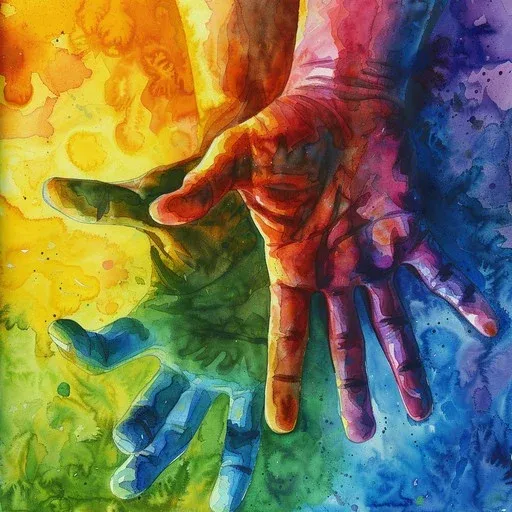
Abstract Hand Paintingoffers a visceral connection between the artist’s physical touch and the medium, stripping away the need for precise realism in favor of raw emotion. When you move your hands across a canvas or a piece of fabric, you are not just applying pigment; you are transferring energy directly from your body to the work. There is an ancient, almost primal satisfaction in feeling the cool texture of the paint against your skin. This art form encourages a departure from the rigid rules of traditional illustration, allowing for a more intuitive and spontaneous creative process that resonates with people of all skill levels.
I remember the first time I set aside my brushes and decided to use my palms and fingers to create a mural on a spare wall in my studio. The experience was transformative because it removed the barrier of a tool. Without a brush between me and the surface, every tremor and every intentional sweep of my hand was recorded in the paint. It felt less like I was “making” a picture and more like I was “feeling” a composition into existence. That is the true heart of this style; it is an intimate conversation between the creator and the canvas.
The beauty of this approach is that there are no mistakes, only shifts in direction. If a color blends in an unexpected way, or if a palm print creates a texture you didn’t anticipate, you simply incorporate it into the evolving narrative of the piece. This freedom makes it an incredibly accessible entry point for those who feel intimidated by the “blank page” syndrome. By focusing on the tactile sensation and the movement of the arms and hands, the brain’s analytical side takes a backseat, allowing the creative subconscious to take the lead.
In modern interior design and high fashion, we are seeing a significant resurgence of this aesthetic. Designers are moving away from mass-produced, digitally printed patterns in favor of the irregularities and soul of a hand-painted finish. Whether it is a bespoke silk scarf or a large-scale abstract canvas, the human element is what gives the work its value. People are drawn to the “imperfections” because they serve as proof of life and proof of a unique human moment captured in time.
The Emotional Freedom of Abstract Hand Painting
When we explore the psychological benefits of Abstract Hand Painting, we find a profound connection to mindfulness and stress reduction. The act of engaging your senses—sight, touch, and even the subtle scent of the pigments—grounds you in the present moment. This sensory immersion acts as a form of meditation, where the worries of the outside world fade away, replaced by the immediate concern of how a certain shade of blue interacts with a smear of gold. Many therapists use this technique to help individuals express feelings that are too complex for words.
The lack of a defined subject matter in abstract work means that the viewer is invited to participate in the interpretation. One person might see a stormy seascape in a series of gray and white hand swipes, while another might see a sense of calm and resolution. As the artist, you are providing a starting point for an emotional journey. By using your hands as the primary tool, you infuse the work with a level of vulnerability that is often missing from more structured forms of art. You are literally leaving your mark on the world.
To begin your own journey, you do not need an expensive set of tools, which is perhaps the most refreshing part of this hobby. A few tubes of high-quality acrylic paint, a sturdy surface like a canvas or heavy-weight paper, and a willingness to get messy are all that is required. Some artists prefer to work on the floor, allowing them to move around the piece and use their full range of body motion. This physical engagement turns the act of painting into a performance, where the movement of the body is just as important as the final image.
Choosing a color palette is often the only “planning” that goes into a session. I usually suggest picking three or four colors that resonate with your current mood. Warm tones like oranges and reds can evoke energy and passion, while cool greens and blues suggest tranquility and introspection. Once the colors are chosen, the rest of the process should be as unplanned as possible. Let your fingers drag through a pool of paint, or use the side of your hand to create a long, sweeping arc that defines the flow of the entire composition.
Modern Techniques in Abstract Hand Painting for Wearable Art
The application of Abstract Hand Painting in the world of fashion has opened up incredible avenues for personal expression. Imagine wearing a denim jacket or a plain white linen shirt that has been transformed into a one-of-a-kind masterpiece. Unlike traditional fabric printing, hand-painting allows for a varied thickness of paint, creating a texture that you can actually feel. This tactile quality turns clothing into a wearable sculpture, making a bold statement about the wearer’s appreciation for artisanal craftsmanship.
When working on fabric, the technique changes slightly to ensure the longevity of the design. Using fabric-specific mediums mixed with acrylics allows the paint to remain flexible and survive the washing machine. The “swipe and pull” method is particularly effective on textiles. By placing a glob of paint at the top of the garment and using the palm of the hand to pull it downward, you create a beautiful, organic gradient that looks like it is melting into the fabric. It is a look that is both edgy and sophisticated.
I once worked with a group of fashion students who were tasked with creating a collection based on “the human touch.” Many of them chose to use their own handprints as repeating motifs, but they obscured them through layers of translucent glazes. The result was a hauntingly beautiful series of garments that looked like they were covered in shadows of memories. This depth is something that a computer-controlled printer can never truly replicate because it lacks the variation in pressure and speed that a human hand provides.
For those interested in exploring this at home, I recommend starting with old clothes that you were planning to donate. It removes the pressure of “ruining” something expensive. You can experiment with different parts of your hand—the knuckles create interesting, repetitive patterns, while the fingertips are perfect for adding delicate highlights. This experimentation is where you will find your own “visual signature,” a style that is as unique to you as your own handwriting.
The concept of layering is vital in creating a professional-looking piece. You might start with a broad, watered-down base of color applied with the flat of your hand. Once that layer is dry, you can come back with more concentrated pigments to add bold, thick strokes. This creates a sense of history within the piece, where the viewer can see the different stages of the creative process. It builds a visual complexity that keeps people looking at the work, discovering new details with every glance.
Another advanced technique involves the use of “resist” materials. You can draw certain shapes or lines with a wax crayon or a specialized masking fluid before you begin your Abstract Hand Painting session. The paint will not stick to these areas, leaving crisp, white lines (or the color of the underlying fabric) amidst the swirls of color. This interplay between the controlled lines of the resist and the chaotic movement of the hand-painted sections creates a dynamic tension that is very pleasing to the eye.
Expertise in this field comes from a deep understanding of the “viscosity” of your paint. By thinning your paint with water or a pouring medium, you can create “runs” and “drips” that interact with your hand movements in fascinating ways. You can tilt the canvas to let the paint wander, then intervene with your fingers to redirect the flow. This collaboration between gravity and human intent is one of the most exciting aspects of abstract work. You are never fully in control, and that is where the magic happens.
Safety is also an important consideration for any artist. When your skin is in direct contact with pigments, it is essential to use non-toxic, artist-grade materials. Many professional acrylics are safe for short-term skin contact, but some pigments contain heavy metals like cadmium or cobalt. Always check the labels for a “non-toxic” certification. If you have sensitive skin, you can wear thin, latex-free gloves, which still allow for a high degree of tactile feedback while providing a protective barrier.
The market for this type of art has grown significantly, especially on platforms like Etsy or at local craft fairs. Collectors are increasingly looking for items that feel “honest.” In a world dominated by polished, AI-generated images, the raw, unedited nature of a hand-painted piece feels like a breath of fresh air. It is a way to own something that a person actually touched and labored over. As an artist, being able to sell a piece of Abstract Hand Painting is a wonderful way to validate your creative journey and share your perspective with others.
When we talk about the longevity of this art form, it is clear that it is not a passing fad. From the very first cave paintings made by blowing pigment over a hand pressed against a stone wall, humans have had a desire to leave their physical mark. We are simply finding new ways to do it using modern materials and contemporary aesthetics. This continuity links us to our ancestors, reminding us that the need to create is one of the most fundamental aspects of being human.
The educational value of this style for children should not be overlooked either. It is an excellent way to develop fine motor skills and sensory processing. More importantly, it teaches children that art is about the joy of the process, not just the perfection of the result. When a child sees their parent engaging in a messy, creative activity like this, it gives them permission to explore their own creativity without the fear of being “wrong.” It fosters a household culture where self-expression is celebrated.
I find that the best time to paint is when I am feeling overwhelmed by words. Sometimes, after a long day of writing or speaking, the last thing I want to do is communicate through language. Turning to a canvas and letting my hands do the talking is a huge relief. There is no need for grammar or logic in an abstract painting; there is only color, light, and motion. It is a way to “empty the cup,” so to speak, leaving me refreshed and ready to engage with the world again.
If you are worried about the mess in your home, consider setting up a dedicated space with a large plastic drop cloth. I have a friend who turned her garage into a “messy studio” where she and her kids can paint whenever the mood strikes. They don’t have to worry about the floors or the furniture, which allows them to be truly free in their movements. Having a space where it is “okay to be messy” is one of the greatest gifts you can give to your creative self.
The evolution of Abstract Hand Painting will likely involve more integration with technology in the future. We are already seeing digital artists using haptic feedback gloves to “paint” in virtual reality, mimicking the sensation of touch. However, I believe the physical version will always hold a special place in our hearts. There is something about the physical reality of a paint-stained hand and a wet canvas that a digital simulation can never truly replace. The smell of the studio and the weight of the paint are part of the experience.
As you conclude a session, take a moment to look at your hands. They will likely be covered in a mosaic of the colors you just used. Those hands have just performed a complex dance of creation. They have navigated the space between thought and reality, leaving behind a visual record of a moment that will never happen exactly that way again. This sense of finality and uniqueness is what makes every piece of art so precious.
The final stage of any painting is knowing when to stop. It is tempting to keep adding “just one more” stroke, but often, the most powerful pieces are those that leave a little room for the viewer’s imagination. When you look at your work and feel a sense of balance—or perhaps a perfect sense of imbalance—it is time to step away. Let the paint dry, wash your hands, and appreciate the fact that you have brought something new into the world.
Whether you are an experienced artist or someone who hasn’t picked up a crayon since elementary school, I encourage you to try this. Do not worry about whether the final product is “good” or “worthy” of a gallery. Focus on the feeling of the paint, the rhythm of your breath, and the freedom of the movement. You might find that you discover a part of yourself that has been waiting for a long time to be heard. Art is a journey, and your hands are the perfect guides to lead the way.
Every stroke is a heartbeat, and every splash is an idea. In the world of abstract art, you are the master of your own universe. You get to decide the laws of physics, the behavior of light, and the meaning of every shadow. This agency is a powerful thing, and it all starts with a single touch. Embrace the mess, celebrate the color, and let your hands tell the story that only you can tell. Your canvas is waiting, and the possibilities are as infinite as your imagination.